Crawl Space Repair & Encapsulation in Huntsville, AL

Sagging floors, damp block walls and a musty smell after winter rain are the classic crawl space complaints here. We connect Huntsville-area homeowners with independent local foundation repair, crawl space and waterproofing companies for free, no-obligation quotes.

Get a Free Quote
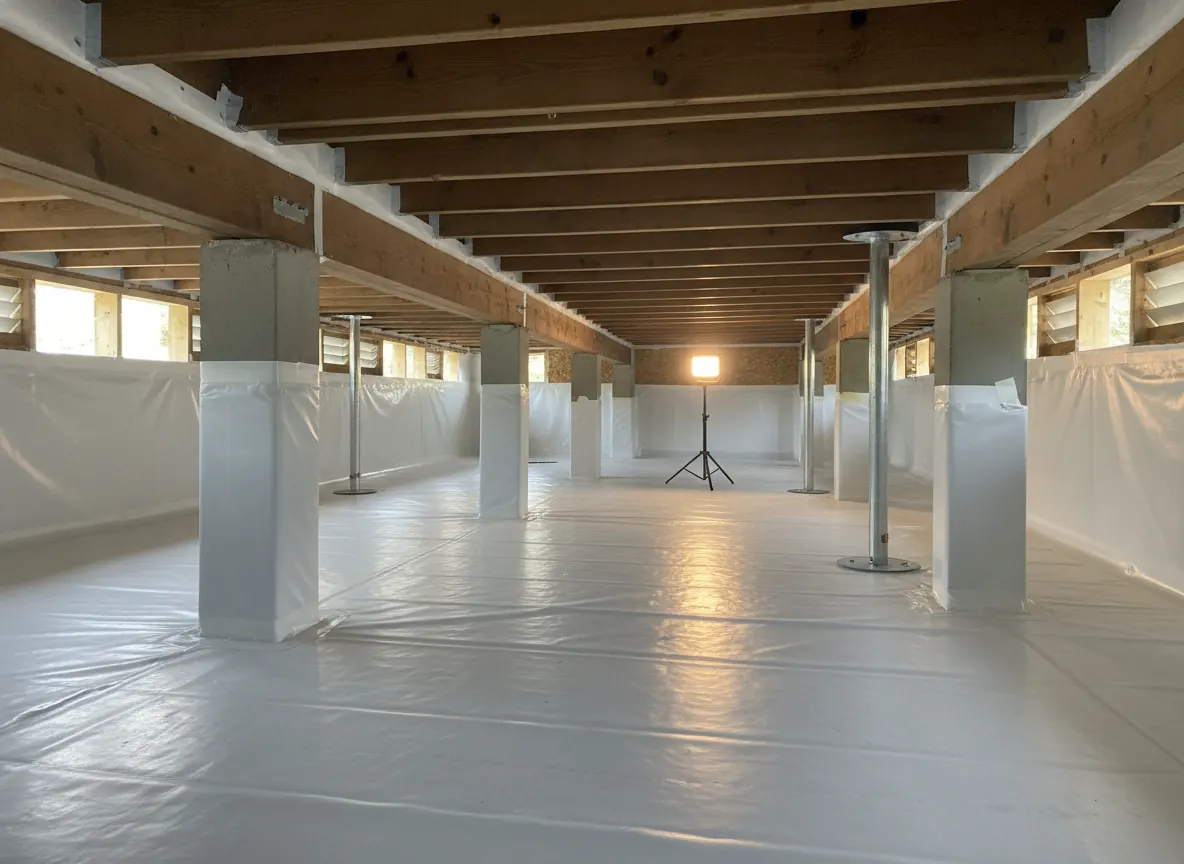
Encapsulated crawl space with white vapor barrier and steel jack posts under beams

Why Huntsville crawl spaces get wet

Huntsville's rain comes in a wet-winter, dry-fall pattern. NOAA 1991–2020 normals for Huntsville International Airport put the annual total at 54.29 inches, with December the wettest month at 5.87 inches and September the driest at 3.49 inches. The area averages 15.5 days a year with an inch or more of rain, and the December-through-February stretch is the wettest season. A vented crawl space takes that water two ways: as surface runoff that finds its way under the house when grading and downspouts are poor, and as humid air that condenses on cool framing and ductwork.

The housing stock makes the issue common. In Madison County, 30.1 percent of housing units were built before 1980 (ACS 2024 1-year), and crawl spaces were the standard foundation of that era in older Huntsville neighborhoods, Decatur and the outlying towns. Slab, crawl space and basement homes are all built here, but the pre-1980 crawl space house with block piers, a wood beam and open vents is the one that most often needs attention. In wet years the problem compounds: 2009 brought 67.70 inches and 2020 brought 70.52 inches, Huntsville's fourth-wettest year, per the UAH Alabama Climate Report, as summarized.

Structural crawl space repair

Fix the framing and supports before anything is sealed.

Joist and beam sistering

Where joists or the main beam have sagged, cracked or decayed from long-term moisture, the contractor fastens new lumber alongside the weak member ("sistering") or replaces a section outright. Decay is cut back to sound wood and the cause of the moisture is corrected at the same time, or the new wood goes the same way.

Jack posts and new piers

Adjustable steel jack posts on new concrete footings pick up a beam that has dropped between the original block piers. The floor is raised slowly, often over more than one visit, to limit new drywall and tile cracks. Where original piers have settled, they are reset, shimmed or replaced. Raising a whole house is covered under house leveling and piers.

Perimeter wall repair

Cracked or bowed block crawl space walls are treated like any foundation wall: tuck-pointing, steel or carbon fiber reinforcement, or underpinning where the footing has settled. Read more under foundation crack and wall repair.

Moisture control: vapor barriers, encapsulation and dehumidifiers

  1. Drainage first

    If water pools in the crawl space after heavy rain, a liner will float or trap it. Companies typically regrade the crawl space floor, add a perimeter drain and sump, extend downspouts and correct exterior grading before sealing anything. See basement and crawl space waterproofing.

  2. Vapor barrier

    Plastic sheeting over the dirt floor, overlapped and taped, blocks ground moisture from evaporating into the air under the house. National guides describe 6 to 20 mil products; thicker liners resist tearing during later service visits.

  3. Full encapsulation

    A heavier liner is run up the foundation walls and piers and sealed at the seams, the vents are closed, and gaps at the rim are sealed. The space is then treated as part of the conditioned house rather than the outdoors.

  4. Dehumidifier and monitoring

    A crawl space dehumidifier drains to the sump or outside and holds the relative humidity down once the space is closed. Ask what humidity level the company designs to and how you will be able to check it; a hard-wired unit or sump may call for the relevant trade licensee.

  5. Insulation and mold treatment

    Insulating the walls instead of the floor is common after encapsulation. Visible mold on framing is usually cleaned or treated before the liner goes in; ask what product and method are used.

Typical costs

Typical national ranges from This Old House (2026), Bob Vila (2024), HomeGuide (2026) and Angi (2026): estimates, not quotes.

ItemTypical range
Crawl space encapsulation$3–$10 per sq ft ($3,000–$15,000; about $5,500 typical)
Vapor barrier alone$2–$4 per sq ft
Interior French drain$60–$120 per linear ft; sump pump $850–$2,800 installed
House leveling$1,000–$3,500 with shims; $10,000–$20,000 when underpinning is needed

The spread between a barrier-only job and a full encapsulation with drainage and a dehumidifier is wide, so ask for the quote itemized by component. Our cost guide and the post on crawl space encapsulation in Huntsville go into more detail.

Licensing, permits and what to ask

Alabama requires a Home Builders Licensure Board (HBLB) residential home builder license for any repair to a home when the cost exceeds $10,000 (Ala. Code §34-14A-2(16)); the HBLB says work that affects structural integrity needs the unlimited license, not the limited one, and licensees must show their license number in advertising and contracts (§34-14A-7). Jobs under $10,000 need no HBLB license. Because encapsulation alone is usually a single trade while beam and pier work is structural, ask which license the company holds for the scope you are buying. Ask for the company's HBLB license number and check it on the HBLB lookup before signing.

In the City of Huntsville a permit is required when labor and materials exceed $250 or any structural work is involved (Inspection Department FAQ); the contractor pulls it and must hold a City of Huntsville business license. Athens and Decatur: permits vary by city; your contractor confirms with the building department.

  • Ask for the warranty in writing: term, what voids it, whether it transfers to a buyer and any transfer fee.
  • Ask how the sump and dehumidifier are serviced and who pays for pump replacement.
  • Ask your insurer what your policy covers.
  • If you rent the home out, §35-9A-204 sets a landlord's duty to make repairs needed to keep the premises habitable; check the current statute or ask a tenant-rights attorney. This is general information, not legal advice.

Request free quotes from local crawl space companies, or call {PHONE_LINK}. We usually reply the same day.

Crawl space FAQ

Is crawl space encapsulation worth it in Huntsville?

It depends on what is wrong. If the floor sags, encapsulation alone will not fix it; the framing and supports come first. If the crawl space is damp, smells musty or shows standing water after winter rain, sealing the floor and walls and adding a dehumidifier addresses the source. Ask each company to separate structural repair from moisture control in the quote so you can compare like with like.

What is the difference between a vapor barrier and full encapsulation?

A vapor barrier is plastic sheeting laid over the crawl space floor, with national guides quoting 6 to 20 mil thicknesses. Full encapsulation seals the floor, piers and foundation walls with a heavier liner, closes the vents, seals seams and usually adds a dehumidifier and sometimes a drain and sump. Vapor barrier alone runs about $2 to $4 per square foot nationally; encapsulation about $3 to $10.

How much does crawl space repair cost?

Typical national ranges: encapsulation $3 to $10 per square foot ($3,000 to $15,000, about $5,500 typical); vapor barrier alone $2 to $4 per square foot; house leveling with shims $1,000 to $3,500, or $10,000 to $20,000 when underpinning is needed. These are typical national ranges from This Old House (2026), Bob Vila (2024), HomeGuide (2026) and Angi (2026), estimates, not quotes.

Does a crawl space company need an Alabama license?

Alabama requires a Home Builders Licensure Board (HBLB) residential home builder license for any repair to a home when the cost exceeds $10,000 (Ala. Code §34-14A-2(16)). The HBLB says work that affects structural integrity needs the unlimited license; encapsulation alone is usually a single trade, so ask which license the company holds. Jobs under $10,000 need no HBLB license. Check the number on the HBLB lookup.

Do I need a permit for crawl space work in Huntsville?

In the City of Huntsville a permit is required when labor and materials exceed $250 or any structural work is involved (Inspection Department FAQ); the contractor pulls it and must hold a City of Huntsville business license. Unincorporated Madison County, including Harvest, Meridianville, Hazel Green, New Market and Toney, requires permits for work of $1,000 or more, per the county's published summary.

Cracks, sticking doors or a sloping floor? Get a clear foundation quote.

Free, no-pressure quotes across Huntsville, Madison, Athens, Decatur, Harvest and Madison County.

Call NowFree Quote